
How to price labour in your auto repair shop (without guessing)
Most workshops price labour by gut feel. Here is the structured method that protects margins and keeps customers coming back.
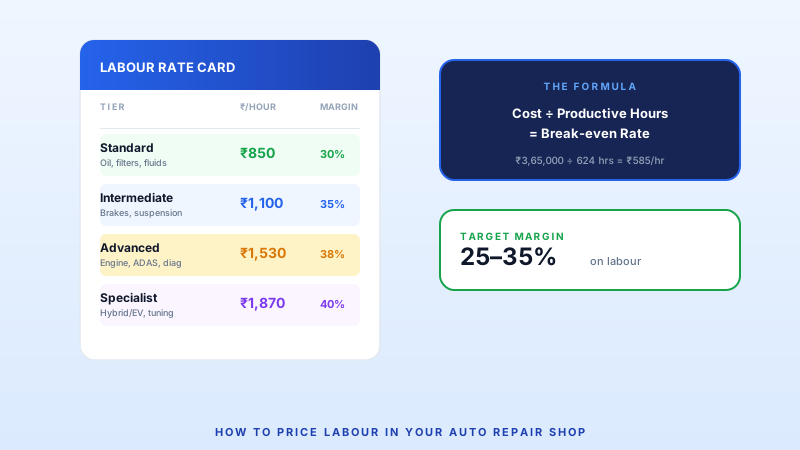
Labour pricing is the single most under-analysed decision in most auto workshops. Ask a workshop owner how they set their labour rate and the honest answer is usually: "I looked at what the shop next door charges and matched it." That's not pricing — it's guessing.
Here is the structured method used by profitable workshops in India and the Middle East.
Step 1: Calculate your cost per productive hour
This is the foundation. Everything else builds on it.
``` Cost per productive hour = Total monthly workshop costs / Total productive hours per month ```
Total monthly workshop costs include:
- Technician salaries (including PF, ESI, bonuses)
- Rent and utilities
- Equipment depreciation (lifts, tools, diagnostic scanners — amortise over useful life)
- Insurance
- Software subscriptions (GMS, accounting)
- Consumables (rags, solvents, disposables)
- Supervisor and advisor salaries (proportioned to workshop time)
- Miscellaneous overhead (training, uniforms, compliance)
Total productive hours per month:
- Number of technicians x working hours per day x working days per month x average utilisation rate
- Example: 8 technicians x 8 hours x 26 days x 80% utilisation = 1,331 productive hours
If your total monthly costs are ₹6,00,000 and productive hours are 1,331:
``` Cost per productive hour = ₹6,00,000 / 1,331 = ₹451 ```
This is your break-even labour rate. Charge less than ₹451 per hour and you lose money on every job, even if parts are profitable.
Step 2: Add your target margin
Most workshops target 25-40% gross margin on labour. Apply it:
``` Selling rate = Cost per productive hour / (1 - target margin %) ```
At 35% target margin: ₹451 / (1 - 0.35) = ₹694 per hour
That's your baseline labour rate per hour.
Step 3: Convert to flat-rate pricing
Customers hate hourly billing — it feels unpredictable. Convert to flat rates using standard labour times from manufacturer service manuals or industry catalogues.
| Job | Standard time | Your rate | Flat-rate charge |
|---|---|---|---|
| General service (4W) | 2.5 hours | ₹694/hr | ₹1,735 |
| Brake pad replacement (front) | 1.0 hour | ₹694/hr | ₹694 |
| AC gas top-up + check | 1.5 hours | ₹694/hr | ₹1,041 |
| Clutch replacement | 4.0 hours | ₹694/hr | ₹2,776 |
Flat-rate pricing benefits both sides: the customer knows the price upfront; you earn more when your technicians are faster than the standard time.
Step 4: Tier by vehicle segment
A Maruti Alto and a BMW 5 Series should not have the same labour rate. Tiering is standard:
| Segment | Multiplier | Example rate |
|---|---|---|
| Budget (Alto, WagonR, i10) | 0.8x | ₹555/hr |
| Mid (City, Creta, Seltos) | 1.0x | ₹694/hr |
| Premium (Fortuner, XUV700) | 1.3x | ₹902/hr |
| Luxury (BMW, Mercedes, Audi) | 1.8x | ₹1,249/hr |
This reflects the genuine difference in complexity, tooling requirements and customer expectations.
Step 5: Review quarterly
Costs change. Rents go up. Salaries increase. New equipment arrives. Recalculate your cost per productive hour every quarter. Workshops that set a rate and forget it erode their margins by 5-10% per year without noticing.
Common pricing mistakes
- Bundling labour into parts price. You can't optimise what you can't see. Even if the customer sees a single line, your system should track parts and labour separately.
- Discounting labour to win the job. Discount parts if you must — parts have variable cost. Labour discounts come straight off your fixed-cost recovery.
- Ignoring waiting time. If a technician waits 30 minutes for parts approval, that's a productive hour lost. Factor it into your utilisation rate, not your labour rate.
- Same rate for all work types. Mechanical, electrical, AC, body — these have different skill requirements and tool costs. Consider category-level rates.
The transparency advantage
Workshops that publish their labour rates (on a rate card, on their website, on the WhatsApp estimate) convert more estimates than those that don't. Transparency builds trust. Customers accept a ₹700/hour rate when they understand what it covers. They reject a ₹500/hour rate when it feels arbitrary.
GetAFix WMS supports tiered labour rate cards, flat-rate catalogues, and automatic margin tracking per job. Set up your rate card in a demo.
Related reading
How to choose the best garage management software in India (2026 guide)
A practical buyers' guide for Indian auto workshops and garage chains — from single-bay independents to multi-city franchises.
AI in automotive workshops: hype vs. reality in 2026
Everyone claims AI. This post cuts through the noise — what AI actually does inside a working garage today, and what is still marketing.