
How fleet managers choose a maintenance partner (and how to win the contract)
Fleet maintenance contracts are the most stable revenue a workshop can get. Here is exactly what fleet managers evaluate — and how to score well.
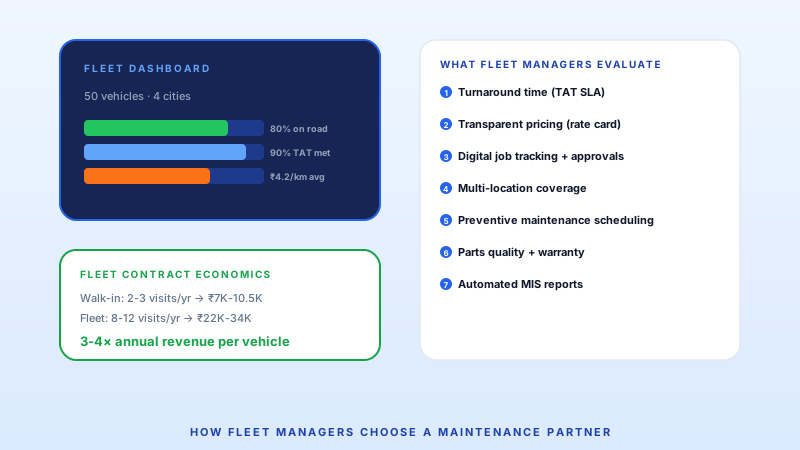
A fleet maintenance contract is the most valuable revenue stream an independent workshop can win. It's predictable, high-volume, and long-term. A 50-vehicle fleet contract at ₹5,000 average per service, serviced 4 times a year, is ₹10 lakh in guaranteed annual revenue from a single client.
But fleet managers are professional buyers. They don't choose workshops based on proximity or price alone. Here is exactly what they evaluate — and how to position your workshop to win.
What fleet managers actually care about (in order)
1. Uptime guarantee
Fleet vehicles earn money when they're on the road. A bus, truck or cab that's in your workshop for 3 days instead of 1 costs the fleet operator ₹5,000-₹15,000 per day in lost revenue.
What they ask: "What is your average turnaround time for scheduled service? For unscheduled repairs?"
How to win: Track and publish your average TAT by job type. If your scheduled service TAT is under 6 hours and unscheduled repair TAT is under 24 hours, you're competitive. Offer a TAT SLA in the contract — e.g., "scheduled service returned same day or 10% discount on that job."
2. Transparent, auditable pricing
Fleet managers manage budgets. They need predictable costs and audit trails.
What they ask: "Can I see a rate card? Can I get monthly reports with cost per vehicle?"
How to win: Publish a fixed rate card with labour rates by vehicle class and common job prices. Provide a monthly fleet report showing: jobs done per vehicle, cost per vehicle, parts vs labour breakdown, and cost per kilometre trend. If you can't produce this report automatically from your GMS, you'll lose to a workshop that can.
3. Digital job card and approval workflow
Fleet managers don't want phone calls asking "should we replace the clutch?" They want a digital estimate on their phone, with photos, that they can approve or reject with one tap.
What they ask: "How do I approve additional work? Do I get photos?"
How to win: Show them the digital estimate approval flow — estimate arrives on WhatsApp or a portal, with line items, photos and a tap-to-approve button. This single feature wins more fleet contracts than any other.
4. Multi-location coverage
Fleet vehicles operate across cities. A fleet manager in Bengaluru with vehicles running to Chennai, Hyderabad and Mumbai needs service coverage in all four cities.
What they ask: "Do you have branches (or network partners) in [city list]?"
How to win: If you're a single-location workshop, be honest about your coverage and consider joining a network. If you're a multi-location chain, highlight your geographic spread and the fact that vehicle history follows the vehicle across branches.
5. Preventive maintenance scheduling
Fleet managers want workshops that proactively schedule services — not workshops that wait for breakdowns.
What they ask: "Will you track service schedules and remind us, or do we have to manage that?"
How to win: Offer proactive PM scheduling — your GMS tracks each fleet vehicle's last service date, current km reading (via GPS integration or driver reporting), and triggers a service booking automatically when the next interval is due. Show them the automated WhatsApp reminder the driver receives.
6. Parts sourcing and warranty
Fleet operators care about parts quality and warranty. Using sub-standard parts that fail early creates downtime — which costs more than the parts saving.
What they ask: "Do you use OEM or aftermarket parts? What's the parts warranty?"
How to win: Offer OEM and quality aftermarket options with clear warranty terms (e.g., 6 months or 10,000 km on aftermarket parts). Keep parts invoices auditable and traceable.
7. Reporting and analytics
This is where most independent workshops lose. Fleet managers need data.
Minimum reporting requirements:
- Monthly cost per vehicle report
- Downtime report (days in workshop per vehicle)
- Preventive vs corrective maintenance ratio
- Parts consumption analysis
- Trend report (cost per km over 12 months)
If you can't auto-generate these from your GMS, the fleet manager's finance team will reject you at due diligence.
The pitch structure that wins
When approaching a fleet manager, structure your pitch around their concerns:
- "Here is our TAT SLA" — with data from your last 90 days
- "Here is our rate card" — fixed rates by vehicle class, no surprises
- "Here is what your approval flow looks like" — show them a live digital estimate on your phone
- "Here is a sample monthly fleet report" — from a current client (anonymised)
- "Here is our coverage" — branches or network partners
- "Here is our PM scheduling" — automated, not manual
Red flags that make fleet managers walk away
- "We'll call you for approvals" (no digital workflow)
- "Pricing depends on the job" (no rate card)
- "We can send reports on request" (not automated)
- "Our technicians are very experienced" (no data to back it up)
- "We don't have a system, but we're very organised" (guaranteed they're not)
The economics
| Contract size | Typical annual revenue | Margin |
|---|---|---|
| 20-vehicle fleet | ₹4-6 lakh | 20-28% |
| 50-vehicle fleet | ₹10-15 lakh | 22-30% |
| 100-vehicle fleet | ₹20-35 lakh | 25-35% |
| 500+ vehicle fleet | ₹1-2 crore | 28-38% |
Margins improve with fleet size because parts procurement gets better volume pricing and technician utilisation improves with predictable job flow.
GetAFix Fleet gives workshops everything fleet managers demand: digital job cards with approval workflow, automated PM scheduling, rate cards, fleet reporting dashboards and multi-location vehicle history. Win your next fleet contract.
Related reading
How to choose the best garage management software in India (2026 guide)
A practical buyers' guide for Indian auto workshops and garage chains — from single-bay independents to multi-city franchises.
AI in automotive workshops: hype vs. reality in 2026
Everyone claims AI. This post cuts through the noise — what AI actually does inside a working garage today, and what is still marketing.