
Cloud vs on-premise garage software: which is right for you?
The honest trade-offs between cloud and on-premise workshop management software — cost, control, compliance and what actually matters.
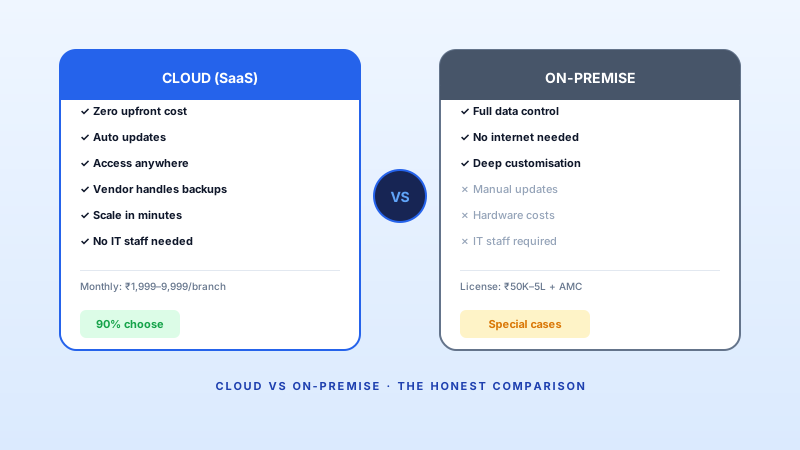
"Should I go cloud or on-premise?" is the question every workshop owner or dealer group asks when evaluating garage management software. The honest answer isn't "cloud is always better" — it depends on your size, compliance needs, internet reliability and growth plans. Here is the real comparison.
What "cloud" and "on-premise" actually mean
Cloud (SaaS): The software runs on the vendor's servers (usually AWS, Azure or GCP). You access it via a browser or app. The vendor handles updates, security patches, backups and uptime.
On-premise: The software runs on a server physically located in your workshop or data centre. Your IT team (or a hired consultant) handles updates, security, backups and uptime.
Hybrid: Core application in the cloud; a local sync agent keeps things running if internet drops. This is increasingly the standard for workshops in areas with unreliable connectivity.
The comparison that matters
| Factor | Cloud | On-premise |
|---|---|---|
| Upfront cost | Low (monthly subscription) | High (licence + server + setup) |
| Total 3-year cost (single branch) | ₹3-8 lakh | ₹5-15 lakh |
| Total 3-year cost (10 branches) | ₹25-60 lakh | ₹40-100 lakh |
| Internet dependency | High | None |
| Update frequency | Continuous (vendor-managed) | Manual (quarterly at best) |
| Data location | Vendor's cloud region | Your premises |
| Disaster recovery | Built-in (vendor manages) | Your responsibility |
| Scalability | Add branches in minutes | Buy more servers |
| Customisation depth | Moderate (API-driven) | High (source access possible) |
| Compliance (data residency) | Check vendor's cloud region | Full control |
| IT staff required | None | 1-2 minimum |
When cloud is the clear winner
- Single-branch or small chain (1-5 locations). You don't have IT staff, and you shouldn't need them. Cloud eliminates server maintenance entirely.
- Fast-growing operations. Adding a new branch to a cloud system takes hours. On-premise takes weeks of hardware provisioning.
- Remote monitoring. Owners who want real-time dashboards from anywhere — phone, laptop, home — need cloud.
- Automatic compliance updates. GST rule changes, ZATCA updates, e-invoicing schema changes — cloud vendors push these to all customers simultaneously.
When on-premise still makes sense
- Large dealer groups with dedicated IT. If you already run 50+ locations with an IT team, on-premise gives you more control over customisation and data.
- Strict data residency requirements. Some Middle Eastern government contracts require data to stay on local infrastructure.
- Extremely unreliable internet. If your workshop has frequent multi-hour outages and no 4G backup, pure cloud is risky. (But hybrid solves this.)
- Legacy integrations. If you must integrate with an old DMS or ERP that only speaks on-premise protocols, the transition cost may not justify cloud.
The hybrid model: best of both worlds
Most modern workshop software (including GetAFix) offers a hybrid architecture:
- Primary application runs in the cloud — accessible from anywhere, always updated
- Local sync agent installed on one machine at the workshop — caches job cards, invoices and inventory data
- If internet drops, the workshop continues operating on cached data. When connectivity returns, everything syncs automatically
- Offline mode on mobile apps — technicians and advisors keep working even during outages
This eliminates the #1 objection to cloud ("what if the internet goes down?") while keeping all the cloud benefits.
Cost deep-dive: the hidden costs of on-premise
On-premise advocates often cite "no monthly subscription" as an advantage. But the hidden costs add up:
| Hidden cost | Typical annual amount |
|---|---|
| Server hardware (amortised over 5 years) | ₹60,000-₹1,50,000 |
| UPS and power backup for server | ₹20,000-₹40,000 |
| Annual maintenance contract (AMC) | ₹50,000-₹2,00,000 |
| IT staff (even part-time) | ₹2,00,000-₹5,00,000 |
| Security patches and OS updates | ₹30,000-₹60,000 |
| Backup infrastructure | ₹20,000-₹50,000 |
| Total annual hidden cost | ₹3,80,000-₹10,00,000 |
Compare that to a cloud subscription of ₹1,00,000-₹3,00,000 per year for a single-branch workshop. The "free" on-premise option is often 2-3x more expensive when all costs are counted.
The decision framework
- Under 5 locations, no IT team: Cloud. No debate.
- 5-20 locations, growing: Cloud with hybrid offline support.
- 20+ locations with IT team: Evaluate both. Cloud is still likely cheaper, but on-premise gives more customisation control.
- Government/military contracts with data residency: On-premise or private cloud.
Security: a non-issue either way (if done right)
Cloud is not less secure than on-premise. In fact, major cloud providers invest more in security than any workshop chain ever will. The real question is: does the vendor encrypt data at rest and in transit, use MFA, and have SOC 2 / ISO 27001 certification? Ask for proof.
GetAFix runs on cloud with a hybrid offline agent for workshops in low-connectivity areas. Data residency available in India, UAE and Singapore. See the architecture in a demo.
Related reading
How to choose the best garage management software in India (2026 guide)
A practical buyers' guide for Indian auto workshops and garage chains — from single-bay independents to multi-city franchises.
AI in automotive workshops: hype vs. reality in 2026
Everyone claims AI. This post cuts through the noise — what AI actually does inside a working garage today, and what is still marketing.